
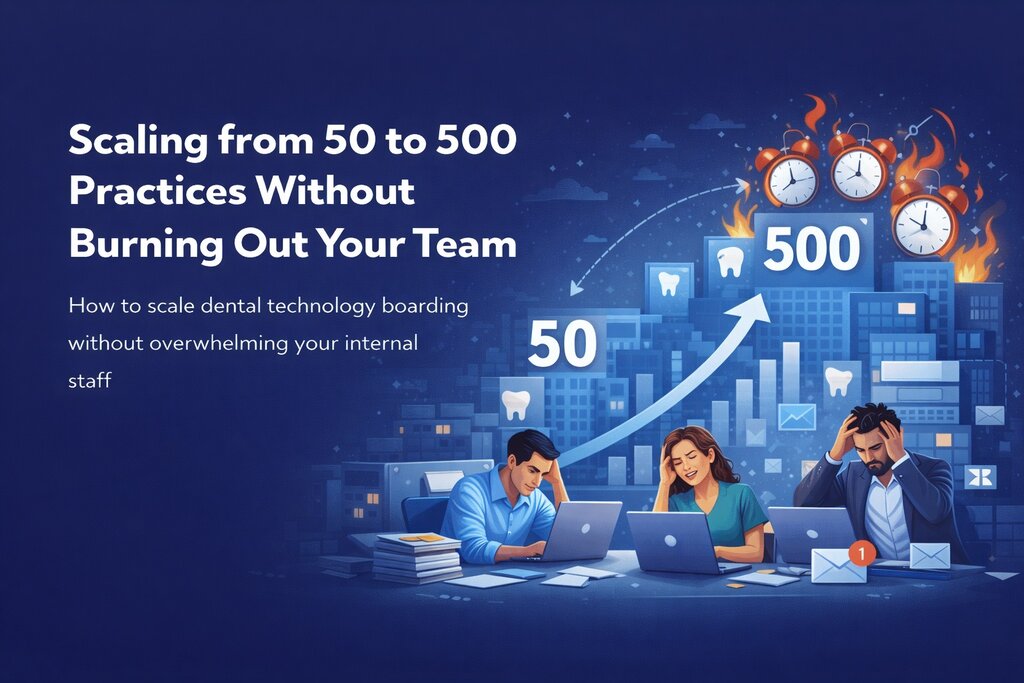
 Scaling a dental SaaS platform from 50 to 500 practices is an exciting milestone, but it’s also where many companies hit their breaking point.
Sales accelerates. Demand surges. Revenue grows. And suddenly, your onboarding team is overwhelmed.
What worked at 50 practices often collapses at 200, let alone 500. The result? Burned-out employees, frustrated customers, delayed go-lives, and stalled growth. The good news: burnout at scale is not inevitable, but avoiding it requires rethinking how onboarding is designed and delivered.
Why Scaling Breaks Teams (Not Just Systems)
Most SaaS teams assume the challenge of scale is technical. In reality, it’s operational.
When onboarding grows linearly with headcount instead of process maturity, teams face:
- Endless manual steps
- Constant exceptions and fire drills
- Context switching between customers
- No clear ownership or accountability
- Pressure to “just get it done”
At 50 practices, heroics work.
At 500, heroics destroy teams.
Burnout doesn’t come from volume alone, it comes from unstructured volume.
The Hidden Cost of Burnout at Scale
Burnout doesn’t just impact morale. It directly affects business outcomes:
- Slower onboarding timelines
- Higher churn during the first 90 days
- Increased error rates and rework
- Higher employee turnover
- Lost revenue due to delayed activation
In other words, burnout becomes a growth tax, one that compounds as you scale.
What Successful Scaling Companies Do Differently
Teams that scale from 50 to 500 practices without burning out their people focus on repeatability over heroics.
1. They Standardize Before They Scale
Every onboarding follows the same core steps:
- Defined intake requirements
- Clear system access rules
- Standard PMS and API workflows
- Consistent validation and handoff
Standardization doesn’t eliminate flexibility, it ensures exceptions are the exception, not the norm.
2. They Design for Speed and Sustainability
Fast onboarding isn’t about rushing. It’s about removing friction:
- No guessing what comes next
- No redundant communication
- No re-explaining the same steps to every client
When onboarding is predictable, teams move faster without working harder.
3. They Separate Sales Velocity from Onboarding Capacity
High-growth companies decouple sales success from onboarding strain by:
- Creating scalable onboarding workflows
- Using dedicated onboarding resources
- Offloading execution when volume spikes
This prevents sales wins from turning into operational crises.
4. They Track the Right Metrics
Instead of focusing only on “getting through the queue,” scalable teams track:
- Time to first value
- Onboarding completion time
- Exception rates
- Customer satisfaction during onboarding
These metrics reveal stress points before burnout sets in.
Why Outsourced or Hybrid Onboarding Becomes a Growth Lever
As volume increases, many dental SaaS companies adopt outsourced or hybrid onboarding models, not to replace internal teams, but to protect them.
This approach allows companies to:
- Absorb onboarding spikes without hiring reactively
- Maintain consistent quality across hundreds of practices
- Free internal teams to focus on product, partnerships, and strategy
The result is not just faster onboarding, it’s healthier teams and sustainable growth.
Scaling Without Burnout Is a Choice
Burnout isn’t a rite of passage. It’s a signal that processes haven’t caught up to growth.
Companies that successfully scale to 500+ practices don’t rely on hustle alone. They build onboarding systems that are:
- Repeatable
- Scalable
- Measurable
- Resilient under pressure
When onboarding is designed to scale, your team doesn’t burn out, your business breaks through.